Introduction
There are two camps in every conversation about AI and the future of software developers right now. One says the profession is basically over. The other insists nothing important is actually changing. Spend enough time thinking about it, and you realize both are looking at the wrong question.
The real question isn't whether AI can write code. It obviously can, and it's getting better at it every month. The real question is: what happens to the job once writing code stops being the hard part?
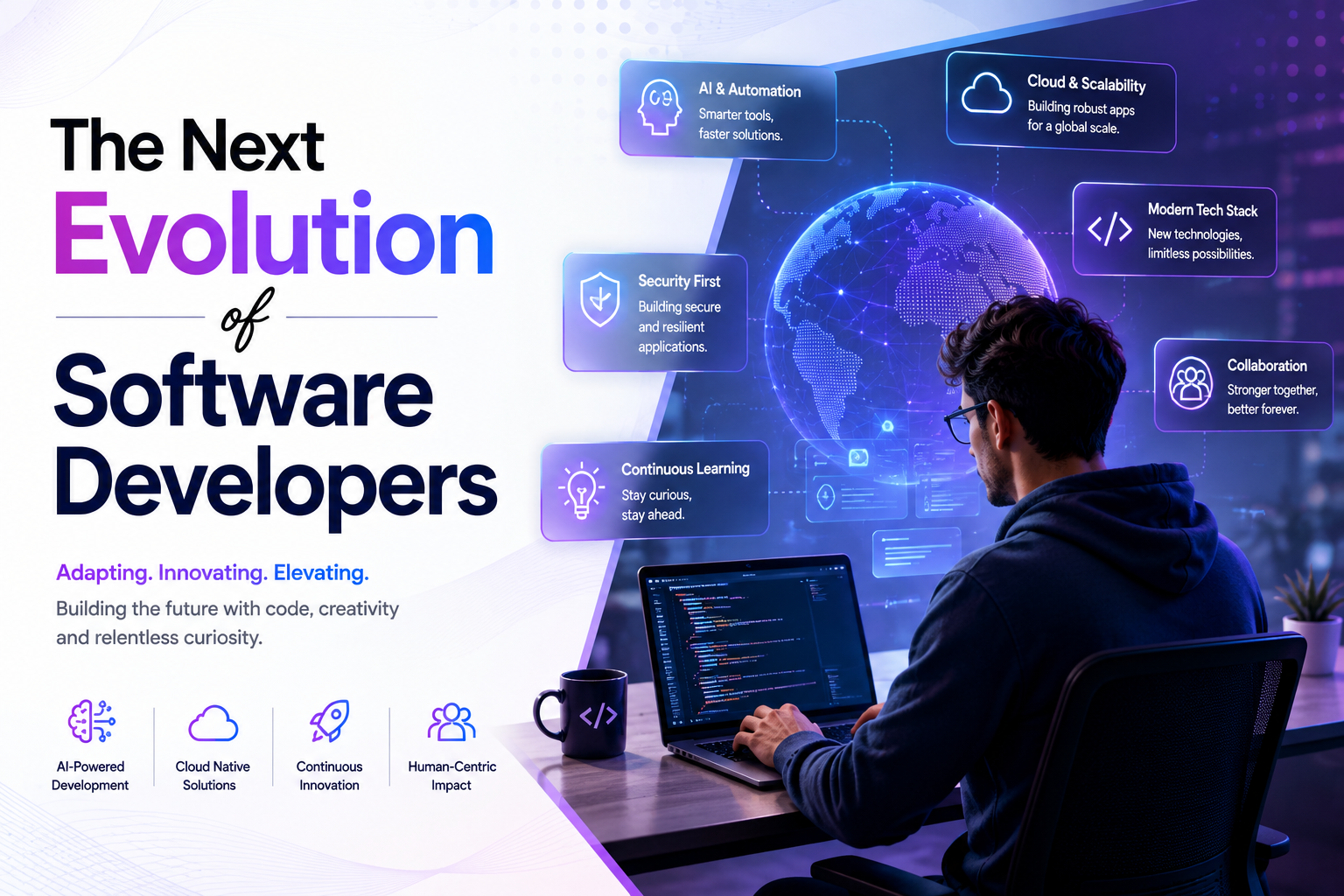
Every Era of Software Has Moved the Work Up a Level
This isn't the first time the ground has shifted under developers. It's just the latest step in a pattern that's been running for decades.
We went from Assembly to high-level languages. We stopped hand-managing memory. Frameworks swallowed up the boilerplate we used to write by hand. Cloud platforms absorbed operational work that once needed entire dedicated teams. Every single one of these shifts did the same thing: it took something developers used to spend hours doing manually and made it disappear into the layer below, freeing people up to work on something higher up the stack.
AI fits that same pattern. It isn't replacing developers — it's pushing the whole profession one level higher, the same way every previous abstraction did. The shift isn't "developers out, AI in." It's "developers move from writing implementation to defining intent, orchestrating the pieces, and owning what happens after."
AI isn't the disruption here. Abstraction is. AI is just the mechanism doing it this time.
From "The Code Is the Job" to "Understanding the System Is the Job"
Go back far enough and a developer's day was almost entirely about the IDE — writing classes, implementing functions, fixing bugs, growing a codebase commit by commit. Code was the language you used to tell a computer what you meant.
As systems got bigger, something shifted. Understanding an existing codebase became just as valuable as writing a new one. Entire careers got built around inheriting legacy systems, figuring out how they actually worked, fixing what was broken without breaking something else, and carefully extending them. Reading code well became a real skill of its own — arguably more valuable, in a mature system, than adding another few hundred lines to it.
We're in the middle of that same kind of shift again, just one layer further out. More and more of the actual work is happening before any code gets written at all — clarifying requirements, weighing trade-offs, designing the architecture, deciding where a plain deterministic function is enough and where you actually need an AI system reasoning at runtime, and reviewing what the AI produces once it exists.
Code is still part of the job. It's just stopped being the part that creates most of the value.
The IDE Stops Being Where Software Is Born
For most of software history, the IDE was the center of everything — the place where every line of code originated. That's changing, and it's changing fast.
Increasingly, the starting point isn't a blank file. It's a description: here's what I want, here's the context, here are the constraints — go build a first version. Whether the tool doing that is Claude Code, Copilot, Cursor, or something that doesn't exist yet six months from now is almost beside the point.
The IDE doesn't vanish. You'll still open files, step through logic, debug the tricky parts, and occasionally write code by hand when it genuinely needs a human touch. But its role flips. Instead of being where software gets created line by line, it becomes where AI-generated implementations get inspected, understood, corrected, and evolved. The center of gravity moves from "writing" to "reviewing" — from implementation toward intent.
Cheaper Code, More Software, Same Amount of Responsibility
There's an economic story underneath all of this too. Yes, running AI systems costs something — tokens aren't free. But stack that against the cost of building the same thing entirely by hand, and it's not close. Implementation, as a raw activity, is getting dramatically cheaper.
That doesn't make software less valuable. If anything, it means far more of it gets built. Ideas that never justified the cost of custom development suddenly become worth doing. A small business can automate something it never could've afforded to before. A single freelancer can ship a product that used to require a whole team. Startups get to test more ideas because trying something no longer means committing months of engineering time to it.
And every bit of that new software still has to live somewhere. It still needs real infrastructure, deployment, monitoring, authentication, payments, storage, and security. The platforms providing all of that — the Vercels, Supabases, Stripes of the world — don't get less important because AI can generate code faster. They become more important, because more software than ever needs somewhere real to run.
Building software gets cheaper. Operating it, maintaining it, being responsible for it when it breaks — none of that gets cheaper at all.
Ownership Becomes the Real Differentiator
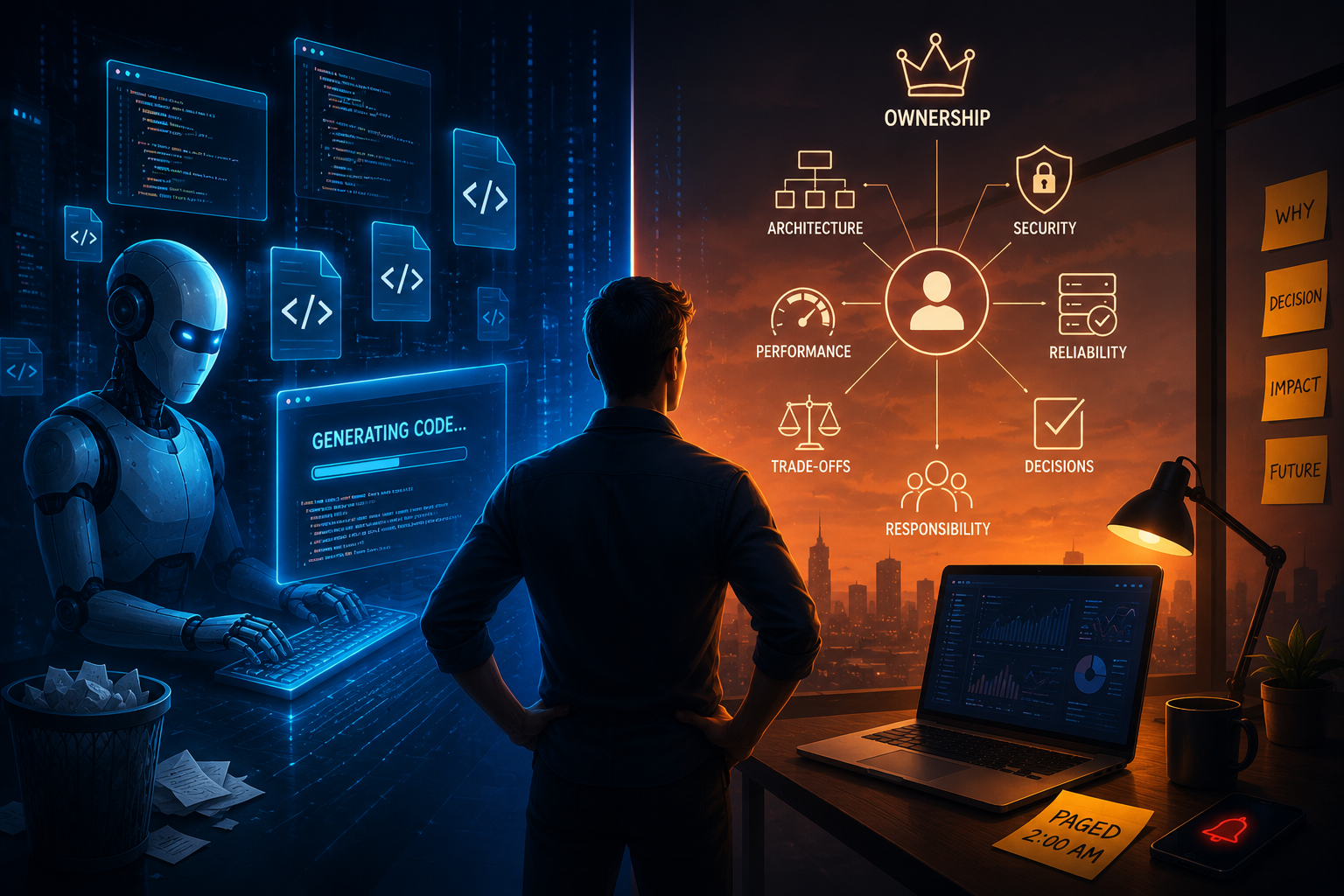
Push this thought experiment all the way: imagine a near future where AI writes every single line of code in a product. Who actually owns that software?
Not the AI. It doesn't own anything, and it can't be held accountable for anything either.
Someone still has to own the architecture. Someone decides how the pieces talk to each other, what level of security is actually required, what performance and reliability the product needs to hit, and which trade-offs are fine to live with versus which ones will quietly turn into a disaster in six months. Someone has to remember why a decision was made in the first place, and whether that reasoning still holds up. And someone is the one getting paged when production breaks at 2am — not the model that wrote the code.
Generating code and owning a product are two completely different things. And the cheaper implementation gets, the more valuable that second thing becomes. As AI removes the friction from producing software, the quality of the decisions around it — architectural, functional, operational — becomes the thing that actually separates good engineering from a pile of code that happens to run.
Software was never really just about producing code. It was always about making decisions and living with the consequences of them. Code can be generated in seconds. Responsibility can't be.
Software Itself Is Getting Less Predictable
There's a second shift happening, this time inside the software itself. For most of computing history, business logic has been deterministic — same input, same state, same output, every single time, no exceptions.
AI breaks that assumption. Applications can now reason at runtime — interpreting language, classifying information, summarizing content, deciding which tool to use next, adapting based on context rather than following a fixed script. Parts of modern systems are becoming genuinely probabilistic instead of purely deterministic.
That opens up a whole category of engineering questions nobody had to seriously ask ten years ago. When should a piece of logic be a plain deterministic function, and when does it actually need an LLM reasoning about it? How do you test something whose correct output can legitimately vary between runs? How much variation is actually acceptable before it's a bug? What happens when the model does something nobody expected?
AI doesn't just remove engineering decisions by handling things automatically. It creates a whole new set of decisions that didn't exist before.
The Real Opportunity Hiding in All This
Here's the part that actually makes this exciting rather than just unsettling.
For a long time, a lot of freelance and consulting work was really just selling implementation — a client had a spec, you estimated the hours, you built it, you billed for the time. That model is under real pressure now, because implementation alone isn't scarce anymore.
But that's not necessarily bad news. It's a different kind of opportunity.
A single experienced developer can now combine AI tools, cloud infrastructure, ready-made auth and payments, a headless CMS, and a handful of specialized APIs to build something that would've needed an entire team just a few years back. The scarce skill isn't "can you build every piece yourself" anymore. It's knowing which pieces to use, how to wire them together sensibly, what's actually worth building custom, what shouldn't be built at all — and most importantly, which problem is actually worth solving in the first place.
That pulls developers much closer to the product itself. Instead of just selling hours of implementation, you're increasingly selling judgment — helping decide what should get built, and owning what happens once it exists. That's really what the word "builder" captures better than "developer" does. A builder isn't measured by how many lines they personally typed. A builder understands the problem, picks the right pieces, puts them together, checks the result, and stays responsible for what it becomes.

The Next Evolution, Not the End
Every major leap in this industry has pushed the work up a level of abstraction without making great engineers less necessary — it's just made a different set of skills the ones that matter most. AI is doing exactly the same thing, just faster and at a bigger scale than any shift before it.
This isn't a demand to become less technical. It's an invitation to apply everything you already know at a higher level — where understanding how systems actually work, making sound decisions under uncertainty, and being willing to own the outcome matter more than they ever did.
That's not the end of software development.
It's just the next version of it.

Frequently Asked Questions
Will AI replace software developers? Not in the way most people fear. AI is automating the mechanical part of writing code, but someone still has to define requirements, design architecture, review AI-generated output, and take ownership of what ships. The role is shifting from implementation to orchestration, not disappearing.
What skills will software developers need in the AI era? System design, architectural thinking, security awareness, and the ability to critically review AI-generated code are becoming the most valuable skills — arguably more valuable than raw coding speed. AI literacy (knowing how to direct and validate AI tools effectively) is quickly becoming a baseline requirement, not a bonus skill.
Is coding still a valuable skill to learn? Yes. Understanding how code actually works is what lets you catch mistakes in AI-generated output, make sound architectural decisions, and know when a shortcut is safe versus dangerous. AI raises the abstraction level — it doesn't remove the need to understand what's underneath it.
What is the difference between a "developer" and a "builder" in this new model? A developer, in the traditional sense, is often measured by how much code they personally write. A builder is measured by whether the right thing got built — understanding the problem, choosing the right tools and components, orchestrating the pieces, and owning the outcome, regardless of how much of the code they typed themselves.
Why does ownership matter more as AI writes more code? Because generating code and being accountable for it are two different things. AI can produce an implementation, but it can't be held responsible when something breaks in production, can't weigh long-term trade-offs the way a human with business context can, and can't explain six months later why a decision was made. That responsibility still falls entirely on people — which is exactly why it's becoming the scarcer, more valuable skill.